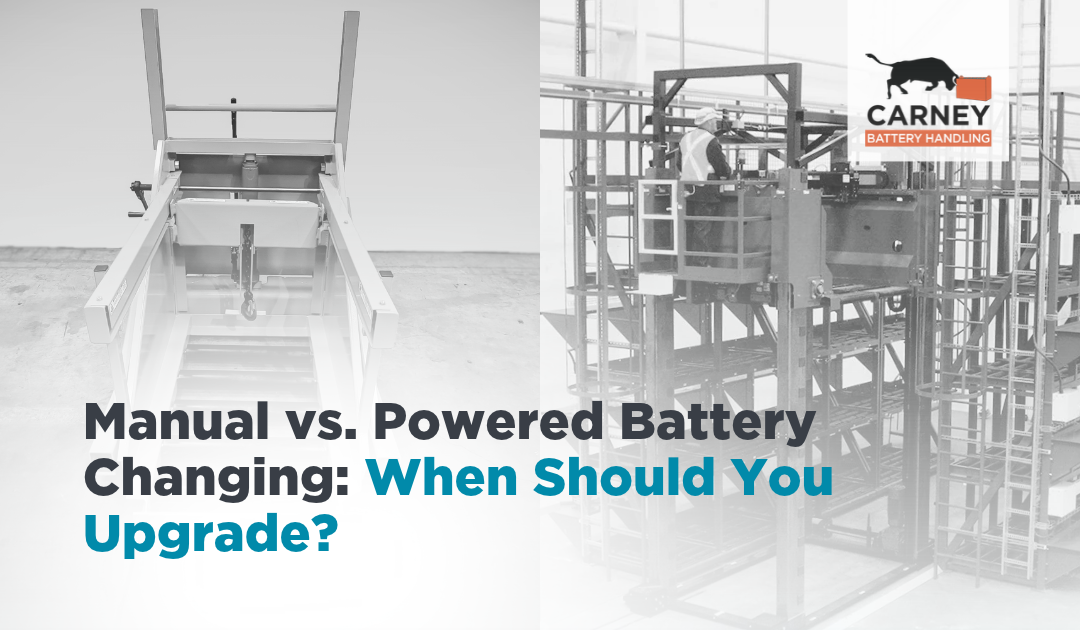
Battery changing is more than a routine maintenance task. It directly affects productivity, operator safety, labour requirements, and equipment availability. As fleets grow, equipment is added and operating demands increase, battery changing methods that once had a positive impact on productivity often become a bottleneck. The right approach depends on fleet size, battery change frequency, available labour, ergonomic considerations, and the cost of equipment downtime.
Understanding the differences between manual, semi-powered and fully powered battery changing solutions can help you determine whether the chosen upgrade will have a positive effect and make operational/financial sense.
Understanding the Three Battery-Changing Approaches
1. Manual Battery Changing
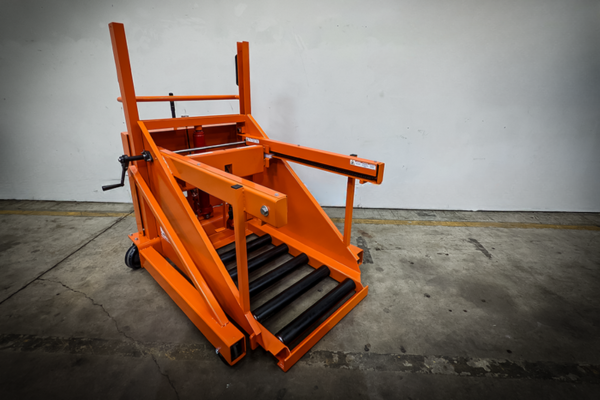
Manual battery changing relies primarily on operator effort and basic mechanical equipment, such as battery rollers, pullers, or other suitable handling aids. The specific process depends on the equipment and battery configuration.
Best suited for: smaller batteries, smaller fleets, occasional battery changes, and operations with relatively low battery change requirements.
Manual solutions can offer a lower initial investment and straightforward operation. For facilities that change batteries infrequently, this approach may be sufficient without introducing additional powered equipment.
However, manual methods can require more physical effort, greater operator involvement, and additional time per change. As workloads increase, these demands may affect productivity and create ergonomic concerns if the process is not properly designed.
Some changers that fit into the manual category:


2. Semi-Powered Battery Changing
Semi-powered systems combine mechanical assistance with some level of powered movement. Depending on the design, power may assist with lifting, positioning, extraction, or transfer, while operators still perform part of the process.
Best suited for: Mid-sized fleets of small to medium sized batteries, moderate battery-change frequency, and operations looking to reduce physical effort without fully automating the process.
Semi-powered equipment can provide a practical middle ground. It may reduce manual handling, improve consistency, and help operators complete battery changes with less exertion.
The main consideration is how much assistance the system provides. A semi-powered solution may address the most demanding steps, but it may not eliminate all manual tasks or deliver the same cycle-time benefits as a fully powered system.
Some changers that fit into the semi-powered category:

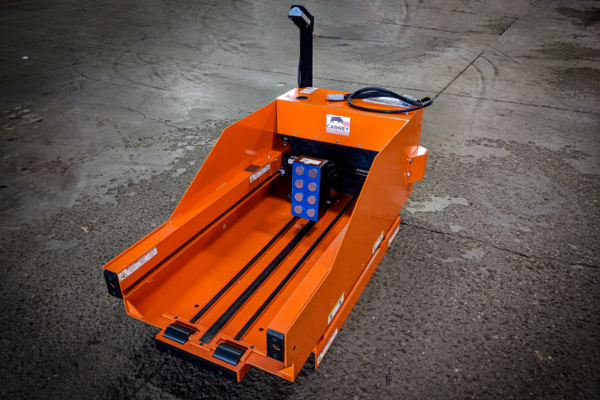
3. Fully Powered Battery Changing
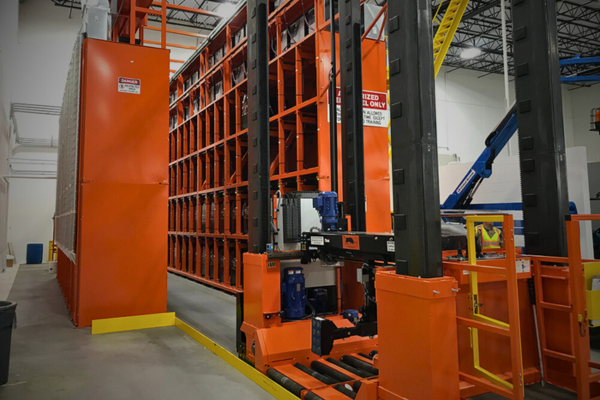
Fully powered battery-changing systems use powered mechanisms to perform key movements involved in removing, transferring, and positioning batteries. The level of automation varies by system, so the actual workflow depends on the equipment selected.
Best suited for: High-utilization fleets, frequent battery changes, multi-shift operations, and facilities where equipment availability is critical. Suitable for all battery sizes up to 5,000lbs (2,268kgs).
Powered solutions can reduce manual effort, improve process repeatability, and help shorten battery-change cycles. They can also reduce reliance on physically demanding tasks, provided the system is appropriately designed and operated.
Although the initial investment is generally higher, the potential gains in labour efficiency, ergonomics, and equipment availability may justify the cost in demanding operations.

The MAC: Mini Auto Changer

The HGC: Hydraulic Gantry Crane

The BBE-FA: Battery Bull Electric Fully Automated
Five Factors to Consider Before Upgrading
Fleet Size and Equipment Utilization
Fleet size is an important starting point, but it should not be the only factor in your decision.
A small fleet operating one shift with occasional battery changes may function efficiently with a manual system. A larger fleet with multiple shifts, high equipment utilization, and limited opportunities to recharge batteries may benefit from a more advanced solution.
The key question is not simply how many forklifts you operate, but how often they require battery changes and how much pressure those changes place on the operation.
Consider upgrading when:
- The fleet has expanded and battery changes are putting pressure on operators.
- Multiple trucks require battery changes at similar times.
- Operators are regularly waiting for a battery change.
- The operation has added additional shifts or longer operating hours.
As utilization increases, the time and labour associated with each battery change can accumulate into a significant operational cost.
Battery-Change Frequency
Battery-change frequency is one of the clearest indicators of whether a manual system remains appropriate.
For operations that change batteries only occasionally, the additional investment in powered equipment may be difficult to justify. However, when changes occur repeatedly throughout the day, even small improvements in cycle time and operator effort can have a meaningful impact on the bottom line.
Track how many battery changes occur per shift, how long each change takes, and whether demand peaks at certain times.
If battery changes are frequent, predictable, and increasingly disruptive, a semi-powered or fully powered solution may offer a better fit.
Labour Requirements and Operating Costs
Manual battery changing can require more direct operator involvement, particularly when the process includes several handling and positioning steps.
As change frequency increases, the cumulative labour requirement becomes more important. Employees may spend a growing portion of their time changing batteries rather than performing their primary duties. Additional coordination may also be needed to ensure the right equipment and personnel are available.
Semi-powered systems can reduce some of this physical and operational burden. To assess the potential return on investment, calculate the current labour cost associated with battery changing.
Use the total labour time required for the process, including assistance from additional employees where applicable.
Then compare the current cost with the expected labour requirements of the proposed system. Factor in purchase price, installation, training, maintenance, and any changes to the battery-changing area.
This approach helps establish whether an upgrade could deliver measurable savings rather than relying on productivity assumptions.
Ergonomics and Operator Safety
Battery changing involves handling heavy industrial batteries and working around material-handling equipment. Poorly designed processes can expose workers to excessive physical exertion, awkward positioning, pinch points, and other hazards.
Manual methods may be appropriate when supported by suitable mechanical aids, safe work procedures, and appropriate training. However, increasing change frequency can make repetitive physical tasks more demanding.
Semi-powered and fully powered systems can reduce operator effort during key handling steps, helping address ergonomic risks when the equipment is selected and implemented correctly.
Signs that your current process deserves a closer ergonomic review include:
- Operators repeatedly applying significant force to move or position batteries.
- Awkward reaching, twisting, or positioning during battery removal or installation.
- Difficulty aligning batteries consistently.
- Growing concerns about fatigue, discomfort, or the physical demands of the task.
An upgrade should form part of a broader risk-reduction strategy, not replace it. Operators still need appropriate training, safe procedures, and equipment designed for the battery weights and truck configurations involved.
When evaluating options, consider how much physical effort remains at each stage of the process, not just whether the system has a powered mechanism.
How to Know When It Is Time to Upgrade
There is no universal fleet-size threshold at which manual battery changing stops making sense. Instead, look for a combination of increasing workload, rising labour requirements, ergonomic concerns, and measurable downtime.
The following guide can help frame the decision:
| Operational Condition | Potential Approach |
| 1. Infrequent changes and low utilization | 1. Manual |
| 2. Moderate change frequency and a need to reduce physical effort | 2. Semi-powered |
| 3. Frequent changes across multiple shifts | 3. Fully powered |
| 4. Battery changes create recurring delays | Evaluate semi-powered and fully powered options |
| 5. Significant ergonomic concerns during repeated handling | 5. Review powered alternatives and other risk controls |
| 6. Rapid fleet growth or increasing throughput requirements | 6. Evaluate future capacity alongside current needs |
These are general guidelines rather than strict rules. A smaller fleet operating continuously may benefit more from powered battery changing than a larger fleet with infrequent changes.
Calculating the Business Case for an Upgrade
The strongest upgrade decisions are supported by operational data.
Start by documenting your existing process. Record the number of changes, total time spent per change, labour involved, equipment waiting time, and any safety or ergonomic issues.
Next, estimate how a proposed solution would change those figures. Request realistic cycle-time estimates from equipment suppliers and account for the actual layout and battery configurations in your facility.
Your cost comparison should include:
- Initial investment: Equipment purchase, installation, and any facility modifications.
- Labour: Changes in the number of employees required and time spent per battery change.
- Equipment availability: Productive time potentially recovered through shorter or more predictable changes.
- Maintenance: Ongoing servicing, parts, and support requirements.
- Training and implementation: Time needed to introduce the new process safely and effectively.
- Capacity for growth: Whether the system can accommodate higher fleet utilization or additional shifts.
Avoid counting the same element twice. A straightforward payback calculation is:
Payback period = total upgrade investment ÷ estimated annual net savings
Net savings should reflect the benefits the business can realistically capture, minus the additional annual operating costs of the new system.
This provides a useful starting point for comparing alternatives and prioritizing investments.
Making the Right Choice for Your Operation
Manual, semi-powered, and fully powered battery-changing systems each have a role in industrial material handling. The right solution is the one that matches your operational demands while supporting safe, efficient, and reliable battery handling.
Manual systems can remain effective for low-frequency applications. Semi-powered solutions offer a practical step toward reducing physical effort and improving process consistency. Fully powered systems are worth evaluating when frequent battery changes, labour demands, or downtime begin to affect productivity.
Before upgrading, assess your current workflow, measure the true cost of battery changing, and identify where your biggest constraints occur. This will help you select a system based on operational requirements rather than fleet size alone.
The best time to upgrade is when the limitations of your existing process begin to cost more—in labour, ergonomics, or equipment availability—than the benefits of maintaining it.
By taking a data-driven approach, you can make a more confident investment decision and build a battery-changing process that supports both current performance and future growth.